
Of all the signs a termite infestation can leave behind, mud tubes are among the most alarming to find and, at the same time, among the most useful. Unlike hollow-sounding wood or scattered frass, mud tubes are visible, physical structures that a colony has deliberately built. Finding one on your foundation, inside your crawl space, or along an interior wall tells you something very specific about what kind of termites you’re dealing with and how established they already are.
For Garden Grove and Orange County homeowners, subterranean termites are the species most likely to be behind what you’re seeing. Understanding what mud tubes are, why termites build them, and how to read what they’re telling you is one of the most practical things you can do to protect your home.
Mud tubes are narrow tunnels that subterranean termites construct to travel safely between their underground colony and the wood they’re feeding on above ground. They’re built from a mixture of soil, termite saliva, wood particles, and termite droppings, which together form a paste that hardens into a durable structure.
Subterranean termites are highly sensitive to environmental exposure. They need moisture to survive, and direct exposure to open air, sunlight, and predators would quickly kill them during transit. Mud tubes solve this problem by creating a climate-controlled highway that protects the colony’s workers as they travel up from the soil to the wood above and back again. Inside the tube, the temperature and humidity stay within the narrow range termites need to function.
A single colony can build and maintain dozens of mud tubes simultaneously, branching in different directions as the colony expands its foraging territory. The tubes can travel across concrete, masonry, metal, and virtually any other surface between the soil and the wood source.
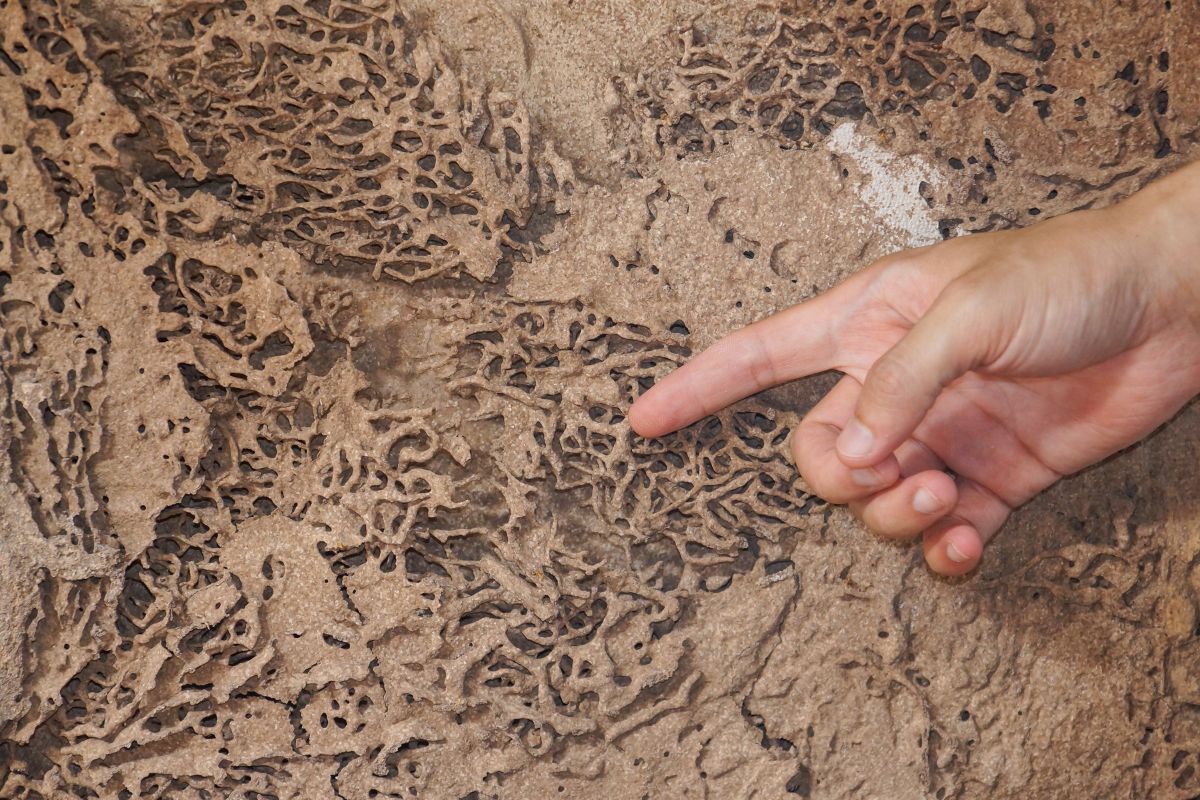
Most mud tubes are roughly pencil-width in diameter, though larger tubes from mature colonies can be as wide as a finger. They run along vertical or diagonal surfaces and have a slightly rough, grainy texture from the soil and wood particles embedded in them. The color tends to match the local soil, so tubes in Garden Grove, where the soil tends toward brown and sandy clay tones, are typically light to medium brown.
They’re most commonly found running up the exterior foundation wall, along the interior of a crawl space, across the surface of concrete piers, and occasionally along interior baseboards or inside wall cavities if the colony has established access points through the slab or framing. They can also appear inside garage walls, in the space behind water heaters, and along plumbing penetrations where the termites have followed pipes through the foundation.
These are the primary highways of the colony. They run from the soil up to an active food source and are used regularly by large numbers of workers carrying food back to the colony. Working tubes are the most commonly found type and the most structurally substantial of the four. If you break a section open and see live termites scrambling inside, you’ve found an active working tube.
Thinner and more fragile than working tubes, exploratory tubes branch outward from the main tube system as the colony scouts for new food sources. They’re often found at the edges of an established tube network and may appear unfinished or irregular in shape. Finding exploratory tubes suggests the colony is actively expanding its foraging territory.
Drop tubes descend from infested wood back down toward the soil. They’re built when the colony establishes access to wood above the tube network and needs to create a return path. Drop tubes have a more uneven, stalactite-like appearance because they’re constructed from the top down using wood particles from the food source above.
Swarm tubes are temporary structures built specifically to allow winged reproductives to exit the colony during swarm season. They’re typically thicker and more irregular than working tubes and appear only during the swarming period. Finding swarm tubes alongside other tube types during late winter or spring is a strong indicator that a mature, reproductively active colony is present.
Not every mud tube you find represents a currently active infestation. Colonies can abandon one section of their tube network when they’ve exhausted a food source or shifted foraging in a different direction. Knowing whether a tube is active or dormant helps prioritize the urgency of treatment.
Break a small section from the middle of the tube, roughly an inch or two, and leave the opening exposed. Check back within 24 to 48 hours. If the colony is active, workers will have repaired the break. Termites repair tube damage quickly because an open tube is a security and humidity vulnerability for the entire foraging party using that route.
If no repair has occurred after 48 hours, the tube may be inactive at that section. However, this doesn’t mean the infestation is over. The colony may have simply shifted its foraging path, and the absence of activity in one tube doesn’t confirm the absence of active tubes elsewhere in the structure.
An inactive mud tube is not a clean bill of health. It means a subterranean termite colony has previously been active at that location. The colony may have treated or died out, but it may also simply have redirected. A professional inspection is the only reliable way to determine whether the tube system is truly abandoned or whether the colony is still active elsewhere in the structure.
Mud tubes can appear anywhere between the soil and a wood food source. The most important areas to check regularly in a Southern California home include:
Many of these locations are out of sight during routine home maintenance, which is why a professional inspection that covers the full perimeter and all accessible interior spaces is so valuable. A trained eye catches tube formation in early stages that a homeowner walking the perimeter wouldn’t typically notice.
The steps matter here, and the order matters too.

Because subterranean termites live underground, effective treatment targets both the above-ground foraging activity and the colony in the soil. MEC’s complete termite control service for subterranean infestations typically involves one or both of the following approaches:
A liquid termiticide is applied to the soil around and beneath the home’s foundation, creating a treated zone that the termites pass through as they forage. The product is transferred back to the colony through contact between workers, eventually reaching and eliminating the queen. Soil barriers are highly effective for active subterranean infestations and provide ongoing protection against reinfestation when properly applied.
Bait stations are installed in the soil around the perimeter of the home. Foraging workers find the bait, consume it, and carry it back to the colony. Over time, the bait disrupts the colony’s ability to molt and reproduce, collapsing the population from within. Bait systems work more slowly than liquid barriers but can be effective for situations where liquid treatment isn’t practical due to soil conditions or structural constraints.
In some cases, particularly when mud tubes have been found inside a crawl space with significant wood damage, treatment is combined with structural wood repair to address both the infestation and the damage it’s already caused.
Garden Grove sits in a zone that’s essentially ideal for subterranean termite activity year-round. The climate stays warm enough that the colony never goes fully dormant, the soil conditions support large underground populations, and the region’s older housing stock, much of it built in the post-war decades with wood framing methods that have since been superseded, offers termites plenty of access points and food.
Homes with aging concrete foundations, raised foundations with exposed wood in crawl spaces, or wood siding that comes close to soil grade are at higher risk than newer construction with treated lumber and sealed concrete perimeters. If your home is more than 30 years old and hasn’t had a professional termite inspection recently, finding a mud tube for the first time is a signal to take seriously.
A mud tube is one of the clearest signals a subterranean termite colony can send. It means the colony has already built infrastructure to reach the wood in your home. The earlier you respond, the less structural damage you’ll be dealing with by the time treatment is complete.
MEC Termite & Pest Control has been inspecting and treating subterranean termite infestations in Garden Grove and across Orange County for over 27 years. Our inspections are free for residential homeowners and we’ll give you a straight answer about what we find.Call us at 714-951-4015 or contact us online to schedule your free inspection today.